



A Spokane Landscaping Company Explains Why One Estimate May Be Thousands of Dollars Higher Than Another
If you’ve ever requested multiple landscaping estimates, you’ve probably had the same reaction many homeowners do:
“How can these prices be so different?”
One contractor quotes $12,000, while another quotes $18,000.
And a third comes in somewhere in between.
At first glance, it may seem like they’re all proposing the same project.
Maybe it’s a paver patio, retaining wall, sprinkler system or complete new landscape installation.
While the drawings may look similar and the materials may have the same brand names, there can be dramatic differences in how the landscape is installed and how long it will last.
Not every landscaping project is built the same.
The lowest estimate isn’t necessarily a poor contractor.
The highest estimate isn’t automatically the best.
But understanding **what’s included—and what may have been left out—**can help you make a much more informed decision.
Landscaping Isn’t a Commodity
Imagine asking three builders to construct the same house.
If one builder pours a thicker foundation, uses higher-quality framing lumber, installs better windows, and pays greater attention to detail, should you expect all three homes to cost the same?
Probably not.
Landscaping works the same way.
Professional hardscaping and landscape construction involve hundreds of decisions that affect durability, appearance, and long-term performance.
Many of those decisions are hidden beneath the finished project.
You don’t see them after construction.
But you’ll certainly experience the difference years later.
Using a Paver Patio as an Example
Let’s use a typical 15′ × 15′ Belgard Avalon Slate paver patio to illustrate where price differences often occur.
The finished patios may look very similar on installation day.
The construction methods behind them, however, can be dramatically different.
| Wall & Company Landscaping | Lower-Cost Installation May Include |
|---|---|
| Approximately 6″ compacted crushed gravel base | Approximately 4″ gravel base |
| Gravel compacted in multiple lifts | Gravel compacted all at once |
| Premium Belgard Avalon Slate pavers | Lower-cost pavers or thinner materials |
| Commercial-grade edge restraints | Economy edge restraints |
| 10″ landscape spikes every 6 inches | Wider spike spacing to reduce labor and materials |
| Polymeric joint sand | Standard joint sand |
| Precision grading for drainage | Minimal grading |
| Careful obstacle cutting | Simpler cuts with larger gaps |
| Thorough cleanup and restoration | Basic cleanup |
Notice that many of these differences aren’t immediately visible.
They’re beneath the patio.
They’re inside the joints.
They’re hidden along the edges.
Those details often determine whether the patio still looks beautiful twenty years later.
The Foundation Is Where Quality Begins
One of the largest differences between landscaping estimates is what happens below the surface.
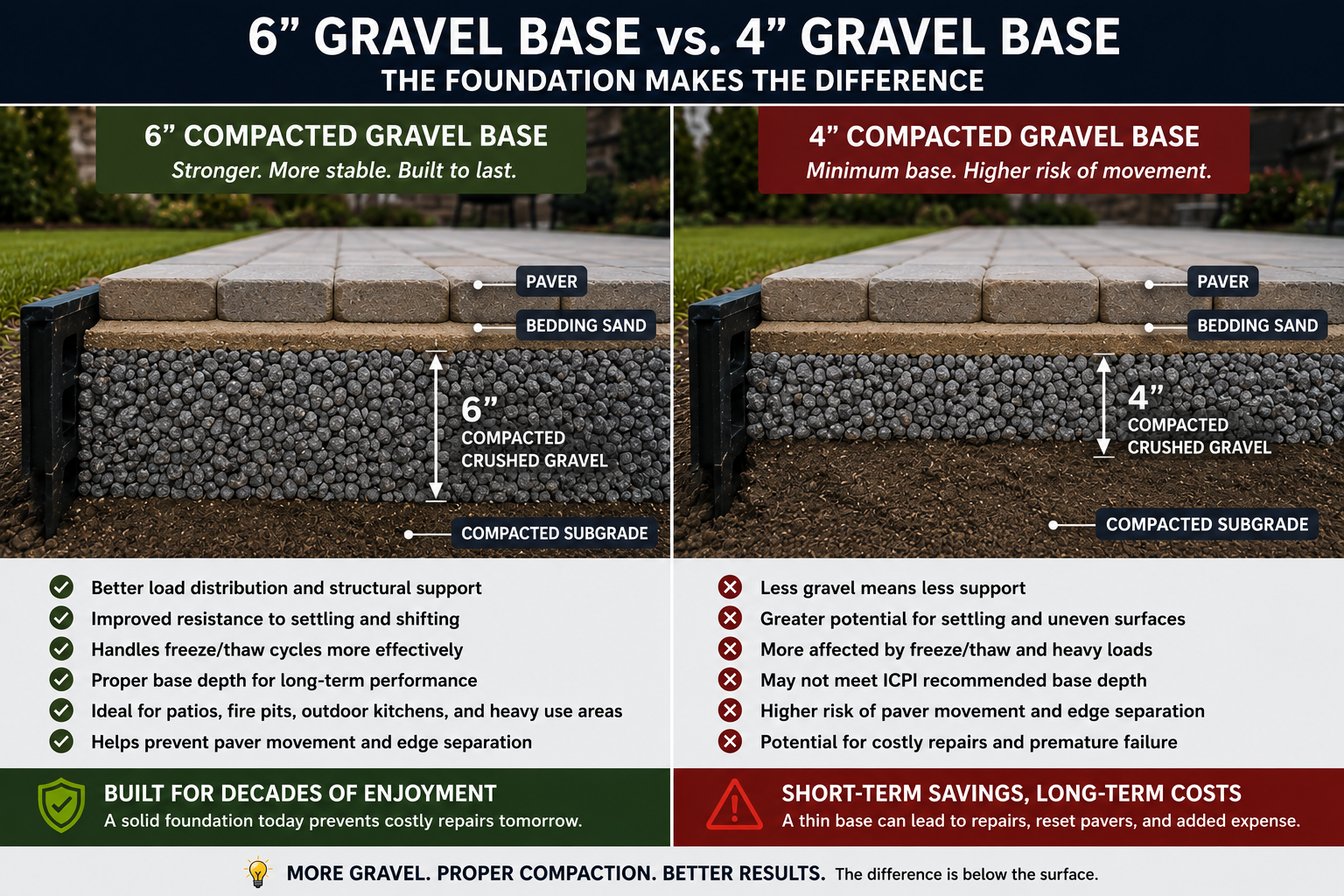
At Wall & Company Landscaping, we typically install approximately six inches of compacted crushed gravel beneath residential paver patios.
Many residential patios are built with approximately four inches.
That additional two inches may not sound significant, but across a typical 225-square-foot patio, it represents approximately 4,500 pounds—more than two tons—of additional crushed gravel supporting your investment.
More importantly, that gravel is mechanically compacted in multiple lifts to create a dense, stable foundation.
A patio is only as strong as the base beneath it.
Investing in a stronger foundation helps reduce the likelihood of settling, shifting, and uneven surfaces over time.
Quality Often Lives in the Details
Another example is edge restraints.
Most homeowners have never heard of them.
They’ll probably never see them after the patio is completed.
Yet they’re one of the most important structural components of the installation.
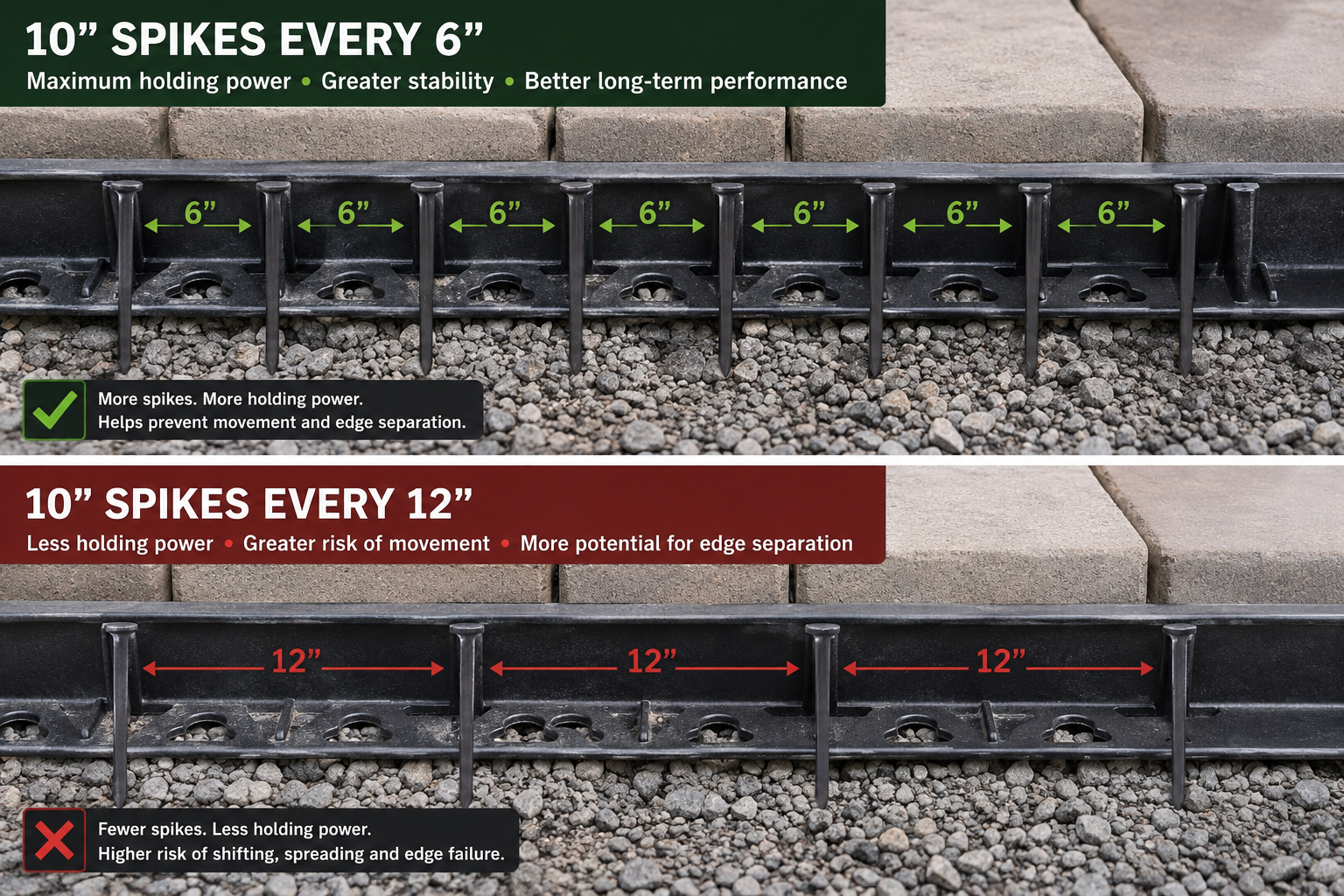
Without properly installed edge restraints, pavers naturally want to spread outward over time.
At Wall & Company Landscaping, edge restraints are typically secured using 10-inch landscape spikes spaced approximately every 6 inches.
Many contractors use fewer spikes or wider spacing to reduce material and labor costs.
Using more spikes creates additional fastening points along the perimeter, helping maintain the structural integrity of the patio for years to come.
While it’s a small detail, the longevity and appearance over time of your project can be substantially impacted.
Sometimes the Property Itself Changes the Price
Not every estimate differs because of construction methods. Sometimes the property itself requires additional work.
Many contractors fail to plan for this, and end up adding up-charges to compensate, once the project has begun.
At Wall & Company, we prefer to measure twice, and cut once.
Factors that commonly increase installation costs include:
Difficult Access
Can excavation equipment reach the backyard?
Or will crews need to use smaller machinery—or wheelbarrows—to transport gravel, pavers, and soil?
Limited access naturally requires more labor.
Distance to the Project
A patio twenty feet from the driveway requires much less material handling than one located 150 feet behind the house.
Every load of gravel, sand, pavers, and excavated soil must be moved that distance.
Soil Conditions
Spokane-area properties vary significantly.
Some contain ideal soil.
Others contain:
- River rock
- Chip rock
- Cobble
- Sandy soils
- Solid basalt requiring hydraulic breakers or jackhammers
These conditions increase excavation time but are impossible to determine from aerial photos alone.
Complex Layouts
Straight patios generally require fewer cuts than patios with curves, circles, decorative inlays, or multiple elevations.
Custom work takes additional time.
The finished appearance is often worth it.
But craftsmanship requires labor.
Obstacles
Patios built directly against homes require precision cutting around:
- Foundations
- Deck posts
- Columns
- Exterior stairs
- Utilities
- Window wells
Those detailed cuts require considerably more time than open layouts.
Landscaping Is More Than Materials
Homeowners often compare material costs because they’re easy to understand.
Belgard pavers.
Plants.
Mulch.
Rock.
Irrigation components.
Those items certainly matter.
But the largest investment in most professional landscaping projects isn’t the materials.
It’s the knowledge required to install them correctly.
Experienced landscape professionals understand:
- Drainage
- Soil conditions
- Grading
- Compaction
- Irrigation
- Plant selection
- Construction sequencing
- Equipment limitations
- Long-term maintenance
- Local climate
Those aren’t things that appear on a material list.
They’re part of the craftsmanship you’re hiring.
Questions Every Homeowner Should Ask
Instead of asking only:
“Why is your estimate higher?”
Consider asking:
- How deep will you excavate?
- How much gravel will be installed?
- How is the gravel compacted?
- What paver brand is included?
- What type of edge restraint system do you use?
- How often are the landscape spikes installed?
- Is polymeric sand included?
- How will water drain away from the patio?
- What warranty do you provide?
The answers to those questions often explain much of the price difference.
The Lowest Price Isn’t Always the Best Value
Every homeowner wants to spend wisely.
That’s understandable.
But landscaping should be viewed as a long-term investment rather than simply a construction expense.
Saving money today may be worthwhile if every contractor is building the project to the same standard.
Unfortunately, that isn’t always the case.
A patio that settles…
A retaining wall that begins leaning…
An irrigation system that wasn’t designed correctly…
Or landscape edging that shifts after a few seasons…
May ultimately cost far more to repair than it would have cost to build correctly from the beginning.
The Wall & Company Difference
At Wall & Company Landscaping, we believe exceptional outdoor spaces are built from the ground up.
Our philosophy is simple:
Build every project as though it were going in our own backyard.
That commitment influences every stage of construction.
For paver patios, that means:
- Approximately 6 inches of compacted crushed gravel
- Gravel compacted in multiple lifts
- Premium Belgard materials
- Commercial-grade edge restraints
- 10-inch landscape spikes every 6–8 inches
- Polymeric joint sand
- Careful grading for drainage
- Precision cutting around foundations and obstacles
- Thorough cleanup and restoration
Will every homeowner need every one of these features?
Perhaps not.
But we believe they’re part of building a patio designed to provide decades of dependable performance.
Final Thoughts
When comparing landscaping estimates, it’s tempting to focus on the bottom-line price.
A better question is:
“What am I getting for my investment?”
The difference between two estimates is often much more than labor or materials.
It’s philosophy.
It’s craftsmanship.
It’s attention to detail.
It’s a commitment to building something that will still perform beautifully years after construction is complete.
Whether you’re planning a paver patio, a retaining wall, a landscape renovation, or a complete outdoor living space, understanding those differences can help you choose the contractor—and the investment—that best fits your goals.
In the end, the least expensive landscaping project isn’t always the least expensive to own.
A project built with thoughtful design, quality materials, and careful construction practices often delivers the greatest value over the life of your home.