



Whether you’re building a small decorative garden wall or a large retaining wall to hold back a hillside, it’s common to receive estimates that differ by thousands of dollars. One contractor may quote $8,000, while another comes in at $14,000 for what appears to be the same project.
So why the difference?
The answer is that retaining walls are much more than stacked blocks.
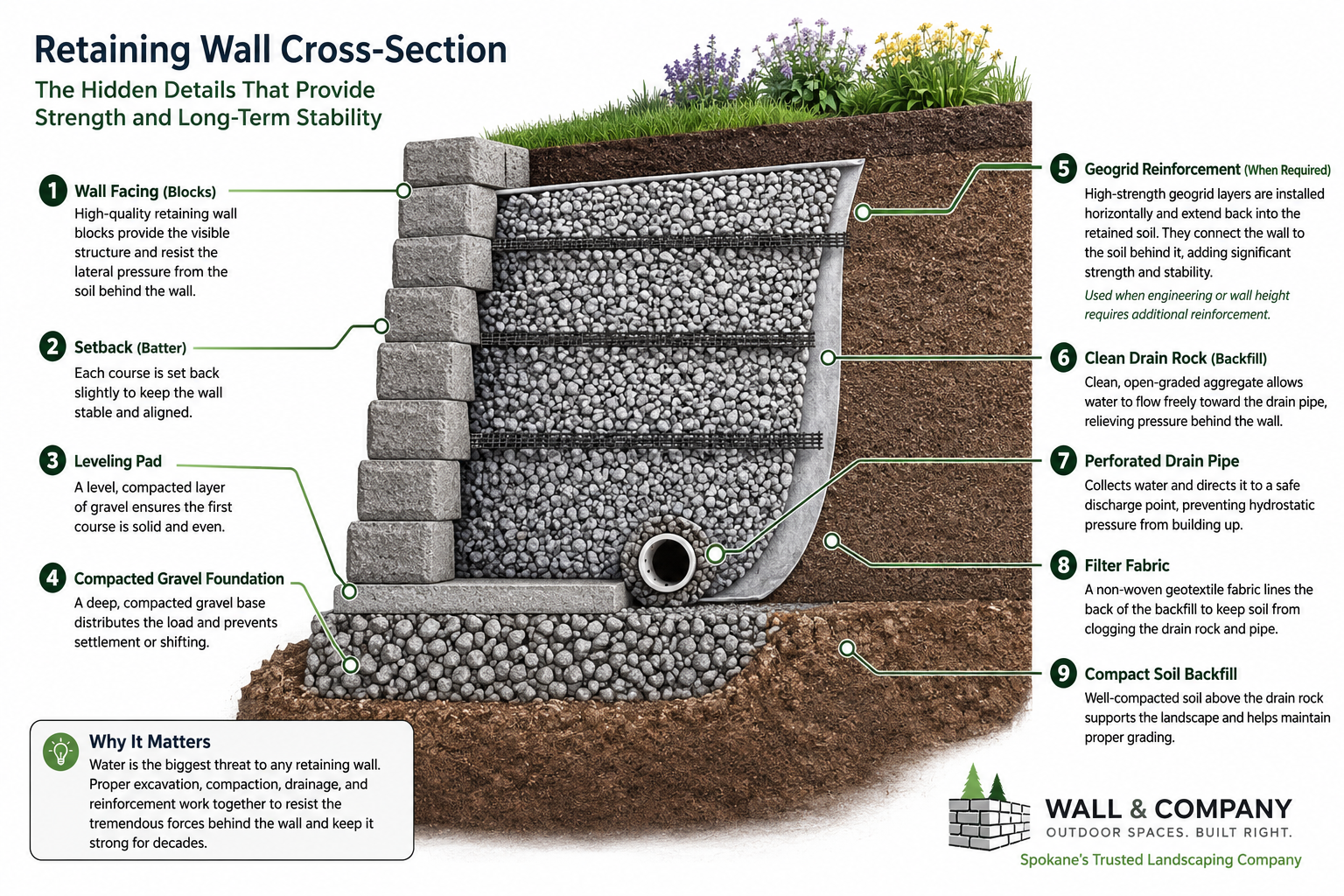
A properly built retaining wall is an engineered structure designed to withstand thousands of pounds of soil pressure, seasonal moisture changes, and Spokane’s freeze-thaw cycles. Much of what determines whether a wall lasts for decades is hidden behind the finished blocks.
As a Spokane landscaping company, Wall & Company believes homeowners deserve to understand those hidden details before comparing estimates.
Premium Installation vs. Budget Installation
| Hidden Difference | Premium Installation | Budget Installation |
|---|---|---|
| Excavation | Proper footing excavation | Minimal excavation |
| Base Material | Deep compacted gravel foundation | Thin gravel base |
| Compaction | Multiple compacted lifts | Single-pass compaction |
| Drainage | Drain pipe and clean drain rock | Minimal drainage |
| Geogrid Reinforcement* | Installed when required | Often omitted |
| Backfill Material | Clean drain rock | Native soil |
| Wall Batter & Alignment | Carefully engineered | Minimal attention |
| Long-Term Performance | Designed for decades | Increased risk of movement |
*Geogrid is used where wall height, engineering requirements, and site conditions call for additional reinforcement.
Details You'll Never See: What's Under the Surface
Wall & Company proudly builds retaining walls with longevity in mind. Details such as multi-lift compacting, using clean drain rock for backfill, geogrid reinforcement and attention to the compacted gravel foundation can be the difference between a retaining wall that lasts for decades instead of years.
Premium Installation vs. Budget Installation
| Hidden Difference | Premium Installation | Budget Installation |
|---|---|---|
| Excavation | Full-depth excavation | Minimal excavation |
| Gravel Base | Minimum 6″ compacted | 3–4″ or less |
| Base Compaction | Multiple compacted lifts | Single-pass compaction |
| Edge Restraints | 10″ spikes every 6″ | Wider spike spacing |
| Joint Sand | Premium polymeric sand | Basic joint sand or lower-quality polymeric sand |
| Drainage Planning | Designed for site conditions | Minimal consideration |
| Materials | Premium installation system | Economy materials |
| Long-Term Performance | Built for decades of performance | Greater potential for settling and repairs |
Wall & Company’s Minimum Construction Standards
| Standard | Wall & Company’s Minimum Standard |
|---|---|
| Excavation | Proper excavation for the wall’s foundation |
| Base Foundation | Properly compacted gravel foundation |
| Base Compaction | Multiple compacted lifts |
| Drainage | Drainage designed for the site’s conditions |
| Backfill | Clean drainage aggregate behind the wall |
| Reinforcement | Geogrid installed whenever engineering or wall height requires it |
| Our Commitment | Build every project as if it were our own home. |
The Hidden Details That Affect Price
1. Everything Starts Below Ground
The strength of a retaining wall begins before the first block is ever installed.
A proper excavation allows room for the foundation that supports the wall. Cutting corners here may reduce installation costs, but it can also reduce the wall’s long-term stability.
2. The Foundation Beneath the Wall
Just like a house needs a solid footing, a retaining wall depends on a properly prepared base.
The gravel foundation distributes the tremendous weight placed on the wall while helping resist settlement.
A thicker, properly compacted foundation generally requires more labor and materials, but it provides the structural support necessary for long-term performance.
3. Multi-Lift Compaction
Simply placing gravel isn’t enough.
Professional installations compact the foundation in multiple lifts, creating a denser, more stable base than attempting to compact the entire depth at one time.
It’s a slower process—but one that contributes significantly to the wall’s durability.
4. Drainage Is Critical
One of the leading causes of retaining wall failure isn’t the blocks.
It’s water.
When water becomes trapped behind a wall, hydrostatic pressure increases dramatically. Over time, that pressure can push a wall forward, causing movement, cracking, or even failure.
Proper drainage may include:
- Perforated drain pipe
- Clean drain rock
- Positive water discharge
- Proper grading
This is one of the biggest differences between premium and budget installations.
5. Backfill Matters
The material placed behind the wall is just as important as the blocks themselves.
Premium retaining walls typically use clean drainage aggregate, allowing water to move freely toward the drain system.
Some lower-cost installations rely heavily on excavated native soil, which can retain moisture and increase pressure behind the wall.
Because this work is buried once construction is complete, many homeowners never realize there was a difference.
6. Geogrid Reinforcement
For taller walls and many engineered retaining walls, geogrid reinforcement becomes an essential part of the structure.
Geogrid is a high-strength synthetic reinforcement that extends back into the hillside, connecting the retaining wall to the soil behind it.
Think of it as giving the wall a much larger footprint beneath the surface.
Not every retaining wall requires geogrid, but when engineering or site conditions call for it, omitting it simply to reduce cost can significantly reduce long-term stability.
7. Alignment and Craftsmanship
A quality retaining wall should appear perfectly straight—or follow graceful curves exactly as designed.
Premium installations pay close attention to:
- Level courses
- Consistent setbacks
- Smooth curves
- Tight joints
- Uniform block placement
Those details contribute to both appearance and structural performance.
8. Choosing the Right Wall System
Not all retaining wall products are created equal.
Different block systems are designed for different wall heights, applications, and engineering requirements.
Selecting the appropriate product for the project—not simply the least expensive option—is another factor that influences both price and long-term performance.
Other Factors That Affect Retaining Wall Pricing
Some projects naturally require additional labor or materials.
| Feature | Typical Impact on Cost |
|---|---|
| Taller walls | Significant |
| Curved walls | Moderate |
| Steps integrated into wall | Significant |
| Limited equipment access | Significant |
| Boulder removal | Significant |
| Engineering requirements | Moderate to Significant |
| Lighting | Moderate |
| Capstone upgrades | Moderate |
Questions Every Homeowner Should Ask Before Hiring
| Question | Why It Matters |
|---|---|
| How will the foundation be prepared? | Determines long-term stability. |
| How is drainage handled behind the wall? | Helps prevent hydrostatic pressure. |
| What material is used for backfill? | Affects drainage and wall performance. |
| Will geogrid reinforcement be installed if needed? | Provides additional structural support. |
| Is the wall engineered if required? | Ensures the wall meets structural demands. |
| What warranty do you provide? | Reflects confidence in the installation. |
Remember: You’re Comparing Two Different Products
Two retaining walls may look nearly identical on the day they’re completed.
What you can’t see is the preparation beneath the wall, the drainage system behind it, the quality of the backfill, or whether reinforcement was installed where needed.
Those hidden details often determine whether the wall remains straight and stable for decades—or begins leaning after only a few seasons.
As a trusted Spokane landscaping company, Wall & Company believes homeowners should understand exactly what they’re purchasing before making an investment. We welcome questions about our construction methods because we believe informed homeowners make better long-term decisions.